
You sit in a waiting room for your child's appointment and the question of how you are doing is never asked.
Jun 12, 2026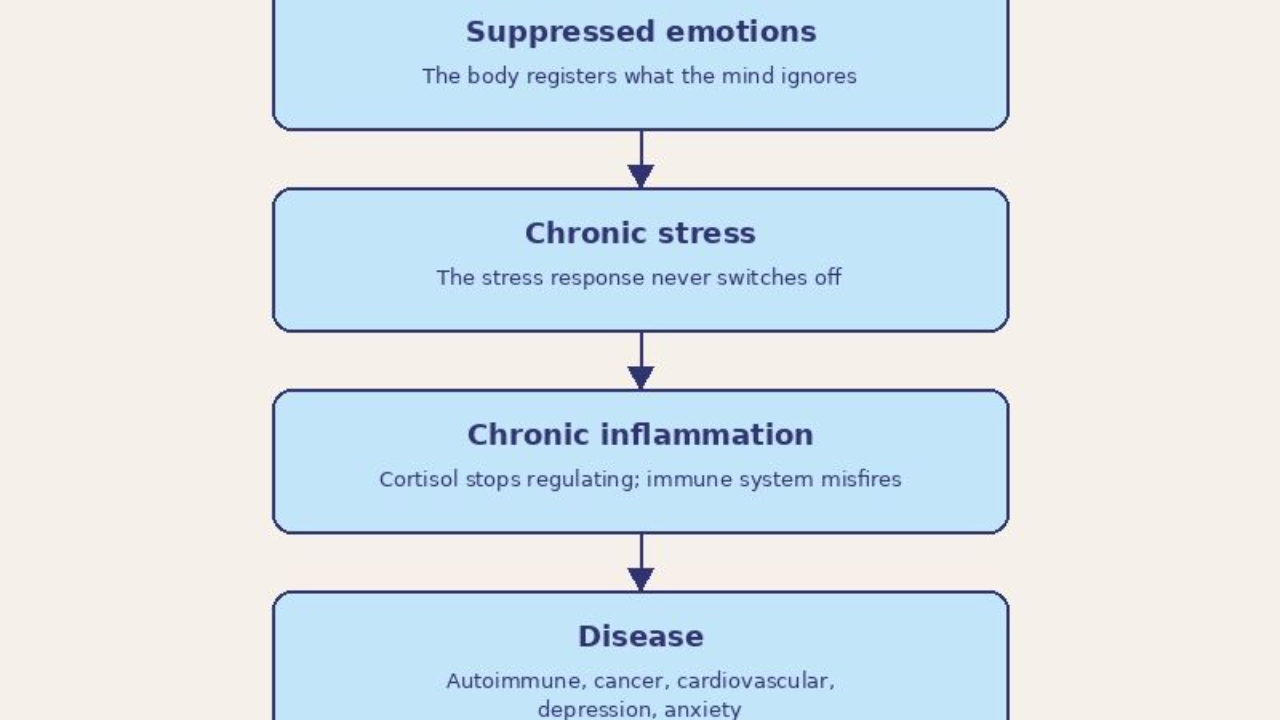
I want to talk about something we see so consistently in the mothers we work with that it stopped feeling like coincidence a long time ago.
They come to us for their child. The school refusal, rage, the anxiety that won't shift. And as we talk, the fuller picture emerges.
Because the vast majority of these women are not just dealing with a struggling child. They are themselves carrying one or more of the following: anxiety, often managed for years. Undiagnosed neurodivergence, masked so effectively that nobody has ever named it. Breast cancer, autoimmune disease and chronic pain all being treated in isolation, without anyone joining the dots. Or postnatal depression, and other forms of mental health issues, that arrived and were managed and then never fully resolved.
I don't think this is coincidence. I think it is cause and effect. And I think it is a conversation society needs to be having far more loudly than it is.
It starts early.
Most of the women we work with were raised, as most women of their generation were, to put other people's needs first. To be good. To be easy. To not make a fuss. Emotions, especially big or difficult ones, were not modelled or coached. They were managed around, ignored, or implicitly treated as a problem.
So these women learned early to suppress. To perform fine over the top of something that really wasn't fine.
We are led to believe that emotions live in our heads. They don't. They are physiological events. When you think or feel something difficult, your body's stress response reacts, cortisol and adrenaline shift, your heart rate changes, your immune system is affected. Emotions are a full-body process.
When emotions are repeatedly suppressed rather than processed, the stress response activates, the signal to stand down never comes. The stress response stays on. Day after day. Year after year.
And a stress response that never switches off is not a stress response anymore. It is a chronic physiological state, and your body will start shouting physically. Research has found that chronic psychological stress causes the body to lose its ability to regulate inflammation, the very mechanism that determines whether disease takes hold. Prolonged elevated cortisol eventually stops working as an anti-inflammatory and starts driving the opposite. The result is persistent, system-wide inflammation. And inflammation, sustained over time, is the underlying mechanism in autoimmune disease, in cancer, in cardiovascular disease, in depression and so on.
This is the chain. Suppressed emotions keep the stress response running. A stress response that never switches off drives chronic inflammation. Chronic inflammation drives disease.
We cannot say this is the only factor, biology is never that simple. But the connection is real, it is in the research, it is evident in our groups every week, and it is still not being talked about enough.
When it doesn't manifest physically, it expresses mentally. Chronic stress has been directly linked to co-occurring anxiety and depression alongside a range of physical conditions.
Either way, the body is registering what the mind was taught to ignore.
And then we become mothers.
Our children arrive and add to an emotional load that was already unprocessed.
Our children need to co-regulate through us. Their physiological state is exquisitely sensitive to ours. They feel our tension. They read our fear. And it tells their own system: this is dangerous, escalate.
We are already dysregulated. The stress response that has been running for years cannot suddenly become the calm, steady presence our child's biology is looking for. So you sit in a waiting room for your child's appointment and the question of how you are doing is never asked.
Your child's big emotions keep landing repeatedly on an already depleted system. You can't hold them. Things escalate. Your child becomes harder to reach. You blame yourself. The shame adds to the load. The load adds to the stress. The stress runs the inflammation higher.
We are still living in a world where the emotional health of mothers is the last thing on the list.
It needs to be the first.
At The Emotions Lab, we put mums first, because you cannot pour from empty. And you cannot be the regulated presence your child needs if nobody has ever helped you regulate yourself.
Contact Us!
Join our mailing list to receive the latest news and updates from our team.
Don't worry, your information will not be shared.
We hate SPAM. We will never sell your information, for any reason.